












For much of the decade following the Global Financial Crisis, investors faced a frustrating problem: there was plenty of money looking for a home, but very little income available from safe investments. Bond yields fell to unusually low levels. Investors responded by reaching further for return into lower-quality credit, less-liquid investments and higher-valued stocks.
That world is changing. Today, there are far more borrowers competing for capital. The federal government needs to finance large deficits. At the same time, companies are investing heavily in artificial intelligence, data centers and power generation. Spending on defense and domestic manufacturing is also rising. More demand for a limited pool of capital has a simple consequence - money costs more. We call this shift “The Great Repricing”.
The change can be seen clearly in the Treasury market. Long-term interest rates have risen considerably, but the increase isn't the result of higher inflation expectations. As the chart below shows, inflation-adjusted Treasury yields have risen while long-term inflation expectations have remained relatively stable.
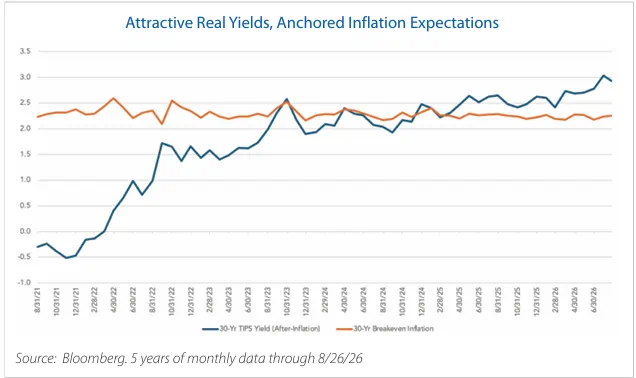
That suggests investors are demanding a higher real return in exchange for committing their money for long periods. For borrowers, that means a higher cost of capital. The outcome is that bonds offer meaningful income again. That is an important change from the years following the financial crisis, when investors often had to accept greater credit, liquidity or market risk simply to generate return.
What Does a Higher Cost of Capital Mean for Investors?
The Great Repricing is about more than whether interest rates stay "higher for longer." When money has a meaningful cost again, it changes the relative attractiveness of investments.
- Quality matters more. When financing was exceptionally cheap, investors could afford to be forgiving. Today, companies with strong cash flows, healthy balance sheets, and the ability to earn attractive returns on new investment should have an advantage over businesses that depend heavily on inexpensive financing.
- Bonds are competitive again. Higher starting yields provide meaningful income and a greater cushion against market volatility. Investors may no longer need to take as much credit or liquidity risk to generate attractive income.
- Taking additional risk should come with additional reward. Private credit and other less-liquid investments can still play valuable roles in a portfolio, but the hurdle has risen. When high-quality public bonds offer attractive yields, investors should demand adequate compensation before giving up liquidity or accepting additional complexity.
- Market leadership could broaden. The previous era rewarded many asset-light businesses that benefited from inexpensive capital. Today's investment boom is creating opportunities in areas such as power, infrastructure, manufacturing, and financial services. That may strengthen the case for diversification across companies, sectors, and regions.
Bonds Can Play a Bigger Role Again
The transition to higher rates was painful for bond investors. But there is an important irony: the rise in yields that hurt bonds on the way up has improved their prospective return on the other side. Higher yields mean investors collect more income while they wait. They also give interest rates more room to decline if economic growth weakens. That doesn't mean stocks and bonds will always move in opposite directions. Inflation or supply shocks can hurt both at the same time. But today's starting point is very different from the prior low-interest rate era. Bonds once again offer meaningful income and the potential to provide portfolio ballast during a traditional economic slowdown.
Touchstone Fixed Income Perspective
- Duration — neutral: With yields already providing meaningful income, we don't believe investors need to make an aggressive bet on falling interest rates. At the same time, a further increase in yields could create a more attractive opportunity to add duration.
- Curve — favor intermediate maturities: We believe the intermediate portion of the yield curve offers an attractive balance between income and interest-rate risk, without requiring investors to take as much uncertainty at the long end.
- Credit — lean into quality: Higher-quality corporate and securitized bonds can provide attractive income without requiring investors to take excessive credit risk.
- Active management — selectivity matters more: A higher cost of capital should create greater differences between borrowers. Companies and financing structures that worked when money was nearly free may look very different when capital has a meaningful cost. That creates opportunities for active managers to distinguish between issuers and securities.
What Could Change Our View?
- Real yields: Are investors continuing to demand historically attractive inflation-adjusted returns?
- Demand for capital: Does heavy government borrowing continue to compete with AI, power and other private investment?
- Corporate behavior: Are higher financing costs beginning to constrain investment or encourage greater capital discipline?
- Long-term Treasury yields: Has the market found a new equilibrium, or will investors demand still more compensation to hold long-term bonds?
- Policy: Can the Federal Reserve and Treasury maintain well-functioning markets without attempting to artificially suppress the market's required return on capital?
The Bottom Line
The information provided reflects the research and opinion of Touchstone Investments as of the date indicated and is subject to change without prior notice. Past performance is not indicative of future results. There is no assurance any of the trends mentioned will continue or forecasts will occur. Investing in certain sectors may involve additional risks and may not be appropriate for all investors.
Please consider the investment objectives, risks, charges and expenses of the fund carefully before investing. The prospectus and the summary prospectus contain this and other information about the Fund. To obtain a prospectus or a summary prospectus, contact your financial professional or download and/or request one on the resources section or call Touchstone at 800-638-8194. Please read the prospectus and/or summary prospectus carefully before investing.
Investment return and principal value of an investment in a Fund will fluctuate so that an investor's shares, when redeemed, may be worth more or less than their original cost. All investing involves risk.
Touchstone Funds are distributed by Touchstone Securities, LLC*
*A registered broker-dealer and member FINRA/SIPC.
Touchstone is a member of Western & Southern Financial Group
Not FDIC Insured | No Bank Guarantee | May Lose Value


