












International Equities Monthly
- The dollar remains an important contributor to our international equity outlook, but recent moves continue to reinforce our view that it is no longer a persistent headwind for U.S. investors abroad. The Dollar Index has remained stuck in a narrow range for more than a year, despite several developments that would typically push it higher.
- Relative interest rates continue to provide mixed signals. U.S. short-term yields remain high, but rate increases abroad have prevented interest rate differentials from widening materially in the dollar's favor. This helps explain why stronger U.S. economic data and expectations for additional Fed tightening have not produced a sustained dollar rally.
- The dollar's response to geopolitical stress is also worth watching. Continued tensions in the Middle East, higher oil prices and rising long-term yields would normally provide support for the dollar, yet the currency has remained relatively contained. The inability of the dollar to strengthen meaningfully despite a more supportive near-term backdrop suggests much of that support may already be reflected.
- Emerging markets benefited from dollar weakness in August, particularly Korea and Taiwan, where stronger currencies added to equity returns. That tailwind could prove less reliable if Fed tightening expectations push U.S. rates and the dollar higher.
- Over the longer term, we continue to believe the dollar has likely passed its secular peak. Large fiscal deficits, gradual reserve diversification and greater currency hedging by international investors remain structural headwinds. For U.S. investors, we no longer view the dollar as a reason to avoid international exposure.
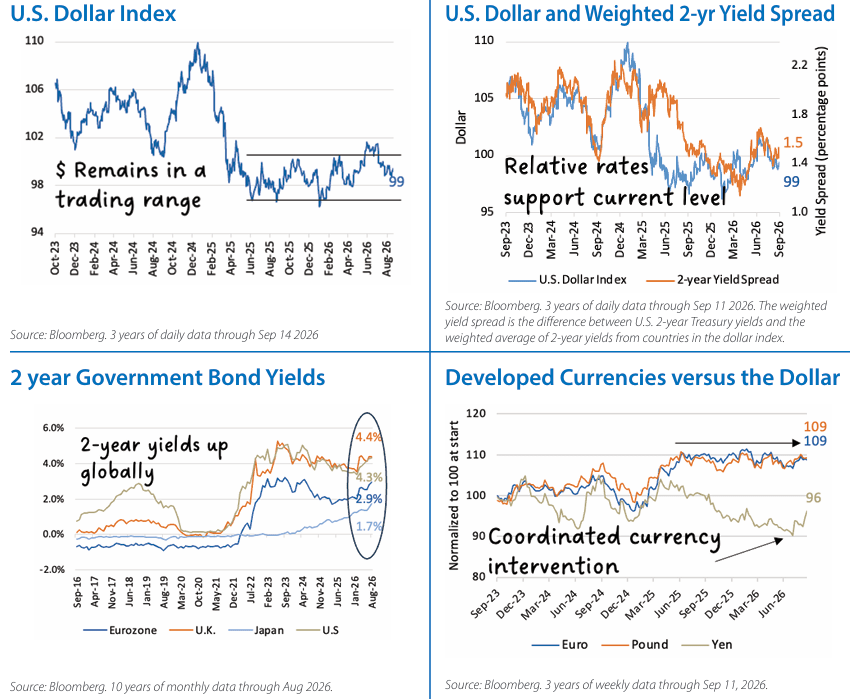
- We remain neutral on developed international equities. Fundamentals remain constructive, but recent market behavior has become more mixed. MSCI EAFE has slipped modestly behind the S&P 500 year to date, with strong Japanese performance offset by renewed weakness in Europe.
- Europe's recent weakness increasingly looks tied to a less friendly discount rate and energy backdrop. European natural gas prices have risen sharply, while long-term government yields have also moved higher. That combination raises costs for businesses and consumers while increasing the discount rate applied to future earnings, helping explain why improving economic data and healthy earnings have not translated into stronger equity performance.
- Japan remains the stronger developed market story. Earnings expectations and price performance continue to move in the same direction, while exposure to semiconductor equipment, automation and robotics provides differentiated growth drivers. A stronger yen and further Bank of Japan tightening remain the principal risks.
- Developed international equities continue to offer diversification from the increasingly AI-heavy U.S. market. Last month we noted that AI-related companies account for a much smaller share of developed ex-U.S. risk than in the S&P 500, providing exposure to global economic growth without the same dependence on the AI investment cycle.
- Taken together, we see insufficient risk/reward asymmetry to move away from neutral. Japan’s earnings and price signals are encouraging, and the dollar remains supportive, but Europe’s weaker relative performance, rising interest rates and natural gas prices, and less convincing earnings revisions keep us from shifting away from our neutral stance.
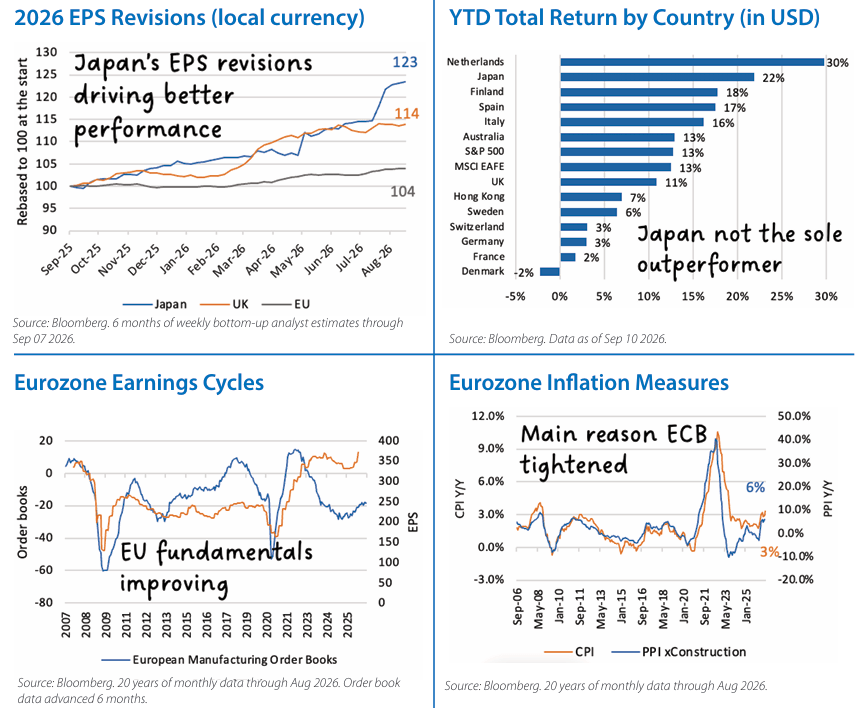
- We remain slightly underweight emerging market equities, although the tension between strong performance and concentrated risk has become even more pronounced. MSCI EM is up 25% year to date through September 10, nearly twice the S&P 500's return and has continued to outperform over the past month. Fundamentals remain strong, with both earnings revisions and price momentum moving higher.
- Concentration remains our primary concern. Taiwan and Korea now represent roughly 48% of MSCI EM, leaving index returns unusually dependent on the semiconductor and AI cycle. Much of that exposure is concentrated in just three semi companies (TSMC, Samsung Electronics and SK hynix) making what should be a broad macro allocation increasingly dependent on a small number of company specific outcomes.
- That concentration remains the central challenge to our slightly underweight position. The issue is not that we are bearish on AI or the three companies driving returns. Rather, an allocation to what should be a broad macro asset class has become increasingly dependent on company-specific fundamentals and a historically cyclical semiconductor industry. That places a macro allocator in the uncomfortable position of making what is increasingly a bottom-up investment decision.
- There are attractive opportunities elsewhere in EM, but they have limited influence on the benchmark. Brazil has been a notable recent outperformer, supported by its position as a net oil exporter, resilient domestic fundamentals and other country-specific factors. Election developments provide an additional catalyst for Brazilian equities. However, at less than 4% of MSCI EM, Brazil is too small to meaningfully diversify the index's dominant Asian technology exposure.
- Taken together, EM earnings and price momentum are strong, but the source of those returns remains unusually concentrated. For a macro allocator, that creates an uncomfortable risk/reward: increasing exposure would effectively require greater conviction in the fundamentals and durability of a handful of historically cyclical semiconductor companies. We would prefer to see a more meaningful broadening of earnings and return drivers before moving toward neutral.
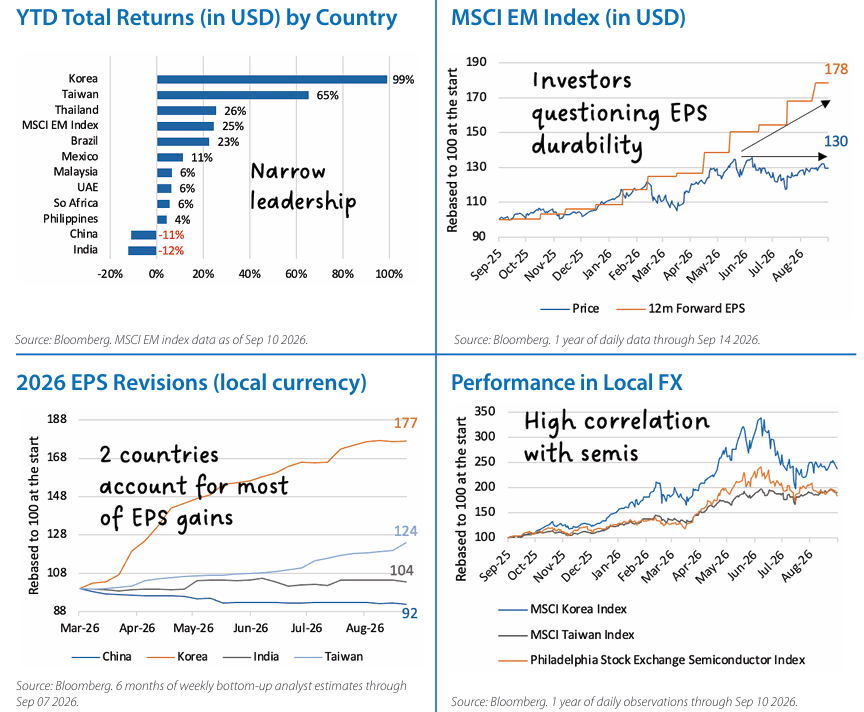
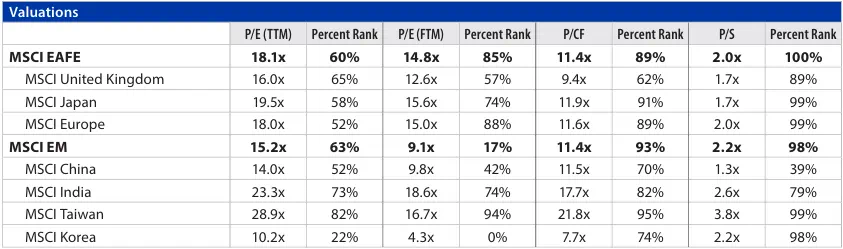
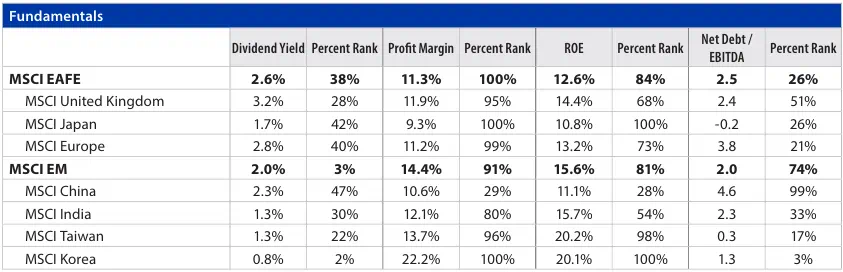
Equity Indexes Characteristics
The Indexes mentioned are unmanaged statistical composites of stock market or bond market performance. Investing
in an index is not possible.
Glossary of Investment Terms and Index Definitions
*Local currency earnings estimates are not available for broad indexes with a mix of currencies.
Source: Bloomberg. Percent ranks are based on 30 years of monthly data as of the end of May; EPS growth estimates based on consensus
bottom-up analyst estimates.
The Touchstone Asset Allocation Committee
The Touchstone Asset Allocation Committee (TAAC) consisting of Crit Thomas, CFA, CAIA – Global Market Strategist, Erik M. Aarts, CIMA – Vice President and Senior Fixed Income Strategist, and Tim Paulin, CFA – Senior Vice President, Investment Research and Product Management, develops in-depth asset allocation guidance using established and evolving methodologies, inputs and analysis and communicates its methods, findings and guidance to stakeholders. TAAC uses different approaches in its development of Strategic Allocation and Tactical Allocation that are designed to add value for financial professionals and their clients. TAAC meets regularly to assess market conditions and conducts deep dive analyses on specific asset classes which are delivered via the Asset Allocation Summary document. Please contact your Touchstone representative or call 800.638.8194 for more information.
A Word About Risk
Investing in equities is subject to market volatility and loss. Investing in foreign and emerging markets securities carry the associated risks of economic and political instability, market liquidity, currency volatility and accounting standards that differ from those of U.S. markets and may offer less protection to investors. The risks associated with investing in foreign markets are magnified in emerging markets due to their smaller economies. Events in the U.S. and global financial markets, including actions taken to stimulate or stabilize economic growth may at times result in unusually high market volatility, which could negatively impact asset class performance. Banks and financial services companies could suffer losses if interest rates rise or economic conditions deteriorate.
Performance data quoted represents past performance, which is no guarantee of future results. The investment return and principal value of an investment in the Fund will fluctuate so that an investor’s shares, when redeemed, may be worth more or less than their original cost. Current performance may be higher or lower than performance data given. For performance information current to the most recent month-end, visit TouchstoneInvestments.com/mutual-funds.
Please consider the investment objectives, risks, charges and expenses of the fund carefully before investing. The prospectus and the summary prospectus contain this and other information about the Fund. To obtain a prospectus or a summary prospectus, contact your financial professional or download and/or request one on the resources section or call Touchstone at 800-638-8194. Please read the prospectus and/or summary prospectus carefully before investing.
Touchstone Funds are distributed by Touchstone Securities, LLC.*
*A registered broker-dealer and member FINRA/SIPC.
Touchstone is a member of Western & Southern Financial Group
Not FDIC Insured | No Bank Guarantee | May Lose Value


