












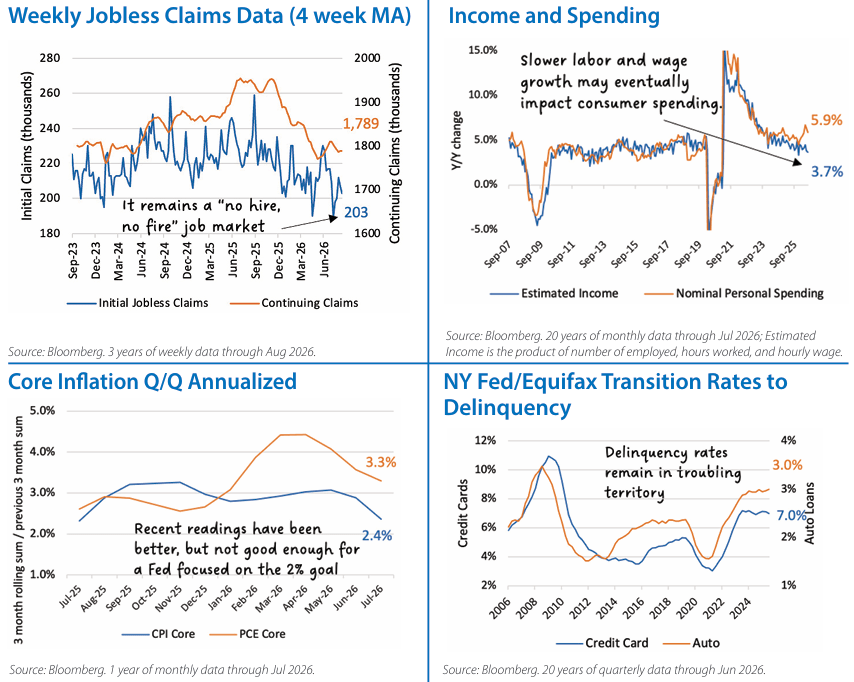
- Growth Is Holding Up: The U.S. economy continues to expand despite slower job growth. AI and data-center investment remain important drivers, while spending on machinery, defense and infrastructure is also supporting activity. The labor market has slowed, but fewer people participating in the workforce means the economy may need fewer new jobs to keep unemployment from rising materially. At the same time, higher interest rates continue to weigh on areas such as housing, leaving growth positive but increasingly uneven.
- The Scrappy Consumer Gets Tested: Consumer spending continues to support growth, but the headline numbers mask greater stress among more vulnerable households. Wage growth has slowed, consumer expectations have weakened, and elevated credit card and auto delinquencies point to continued financial pressure. Consumers are still spending and adapting to higher prices, but slower income growth leaves less room to absorb another increase in energy prices or inflation.
- Disinflation Meets Repeated Shocks: Recent inflation reports and slower wage growth offer encouraging signs that underlying price pressures are easing, while long-term inflation expectations remain comparatively well anchored. But the path back to the Federal Reserve's 2% target continues to face interruptions. Renewed hostilities in the Middle East, elevated energy costs and escalating U.S.-Canada trade tensions could put renewed pressure on transportation, business and consumer costs. Disinflation may continue, but repeated supply shocks make a smooth path back to 2% increasingly unlikely.
- The Fed's Bar Has Moved: Chair Warsh used Jackson Hole to make clear that better recent inflation readings have not yet established a sustainable path back to 2%, effectively putting a September rate hike on the table unless incoming data provide a reason to take it off. A hike would immediately raise another question: will further tightening follow later this year or early next? Under Warsh's less-is-more approach, the Fed may provide little guidance about what comes next, leaving markets more sensitive to each new economic report and potentially increasing interest-rate volatility.
- Stay Invested, Stay Measured: Continued economic growth and healthy corporate earnings support our moderate overweight to equities relative to fixed income. But growth is becoming more concentrated, some consumers are under greater pressure, and repeated inflation and geopolitical shocks leave less room for policy error. We remain constructive on risk assets, but believe the backdrop favors measured positioning rather than adding risk, with diversification increasingly important as the range of potential outcomes widens.
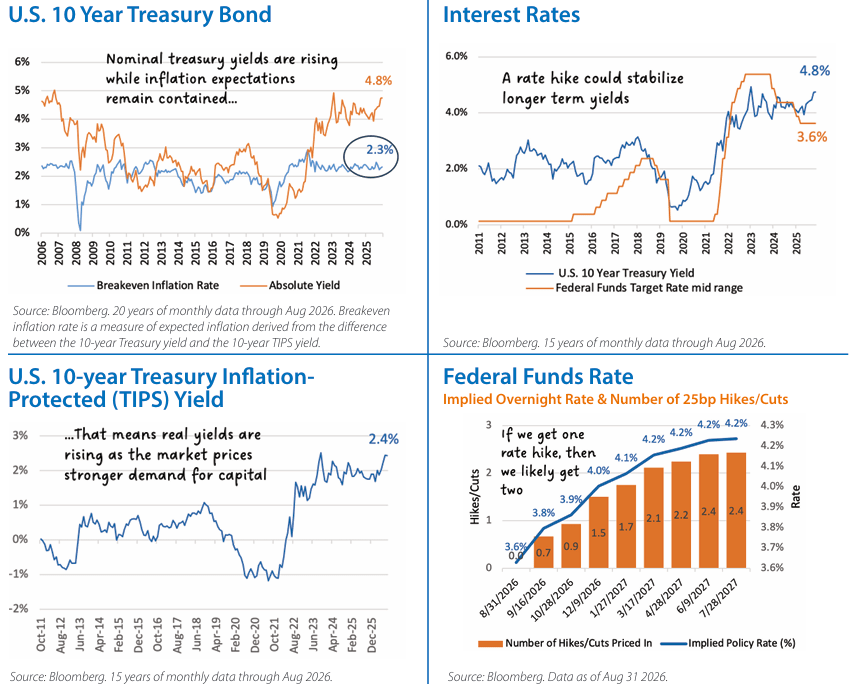
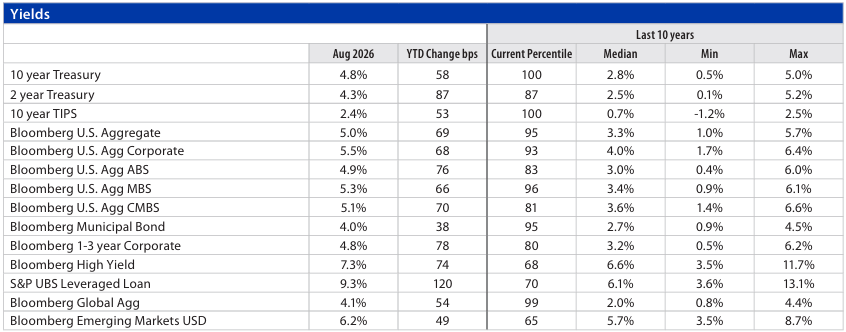
- Capital Has More Choices: The U.S. Treasury must finance large deficits while AI infrastructure and other private borrowers also require significant capital. Rising developed-market sovereign yields give global investors more alternatives. Growth, inflation and Fed policy remain important drivers of rates, but greater competition for capital means borrowers increasingly need to offer sufficient yield to attract investors.
- Treasury Responds: With deficits near 6% of GDP, Treasury Secretary Bessent has increased buybacks of longer-dated Treasuries and relied more heavily on short-term bills, while recent currency-market intervention underscores the importance of maintaining foreign demand for U.S. debt. These actions can improve market functioning, but Treasury's ability to influence long-term borrowing costs remains limited without more significant steps that could bring unintended consequences.
- The Market Sets Long Rates: The Fed remains an important influence on short-term rates, but its influence diminishes farther out the yield curve. Growth, inflation, Treasury supply and the compensation investors demand for longer-term risk increasingly determine long rates. With fewer price-insensitive buyers such as the Fed and foreign central banks, private investors now play a larger role in determining the yield needed to attract buyers.
- Neutral, Not Bearish: We moved from a slight duration overweight to neutral in August as the case for taking additional interest-rate risk became less compelling. Growth has held up, while government financing needs and competition for capital continue to pressure the long end. We favor intermediate maturities and remain patient about adding duration. Should growth weaken meaningfully, Treasury yields can still fall, and high-quality bonds can provide important portfolio diversification.
- Income Is Doing Its Job: Higher yields pressure bond prices but also provide more income to offset those declines. Over the past 12 months, the Bloomberg U.S. Aggregate Bond Index returned 1.89% despite a -2.16% price return, as 3.90% of coupon income helped absorb the decline. If yields remain elevated, investors continue collecting higher income; if yields fall, income can be supplemented by price appreciation. Higher starting yields provide a larger cushion against rate volatility while increasing potential upside if rates eventually decline.
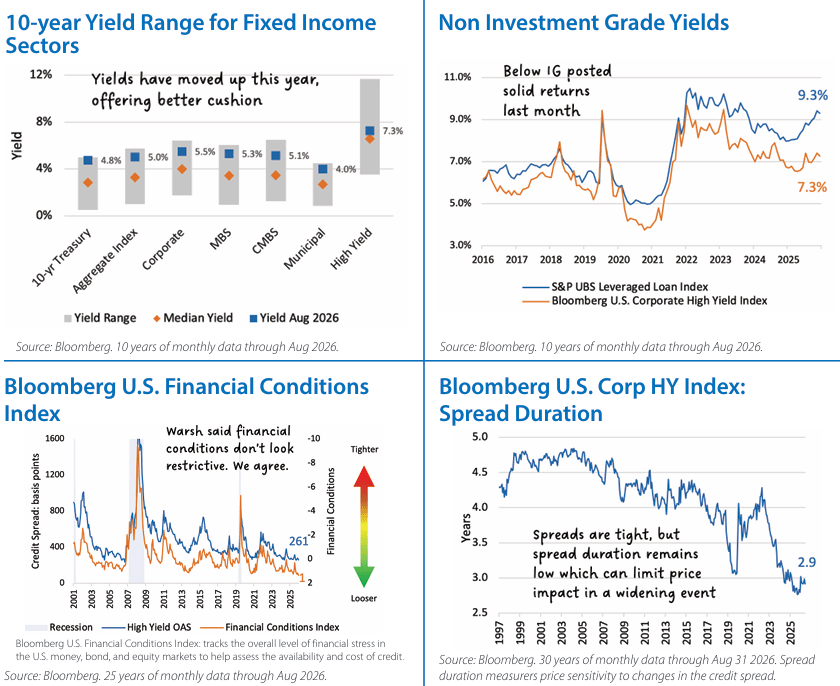
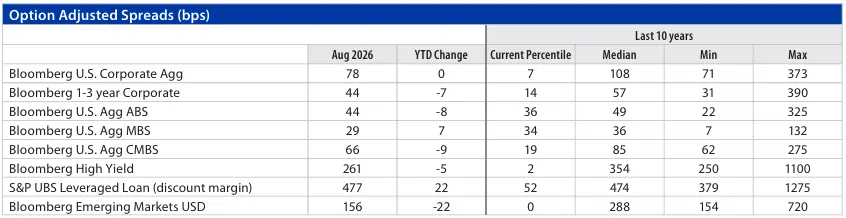
- Capital Gets More Selective: The AI buildout continues to require enormous amounts of financing, but the story is shifting from how much capital is needed to how that capital gets allocated. Funding remains readily available to stronger borrowers, particularly hyperscalers with substantial cash flows and balance-sheet capacity, while more leveraged issuers and projects increasingly need to offer investors greater compensation and stronger protections. Capital remains available, but financing is becoming less automatic as investors focus more closely on credit quality, project economics, and structure.
- New Issues Favor Lenders: Tight secondary-market spreads can obscure improving conditions for investors in the new-issue market. Capital-intensive borrowers are increasingly offering wider pricing, discounts and stronger protections for lenders to secure financing, while some lower-quality borrowers are extending maturities in exchange for more favorable terms for investors. For active managers able to be selective, new issuance can therefore offer better risk/reward than broad credit-market valuations might suggest.
- AI Reshaping High Yield: Last month, we highlighted the growing impact of AI-related borrowing on the investment-grade market. That financing wave is increasingly reaching high yield. Data centers account for just over 3% of the outstanding high-yield market but roughly 40% of non-refinancing issuance in 2026. Through mid-July, approximately $32 billion of AI-related high-yield debt had been issued, including roughly $28 billion to finance new data centers. The opportunity is also expanding into fiber and network connectivity, power generation, electrical infrastructure and semiconductor components. Rapid growth creates opportunities, but construction, power availability and tenant risks make selectivity particularly important.
- Diversify With Credit: Opportunities extend beyond corporate bonds. We continue to favor areas such as seasoned non-agency RMBS, selected CMBS and asset-backed securities, where protections designed to absorb losses and diversified pools of underlying loans can provide attractive income while reducing reliance on any single borrower. Principal repayments and other cash flows also return capital that can be reinvested at today's higher yields. We remain selective, particularly where weaker consumers, leveraged borrowers or challenged commercial properties increase risks to the underlying collateral.
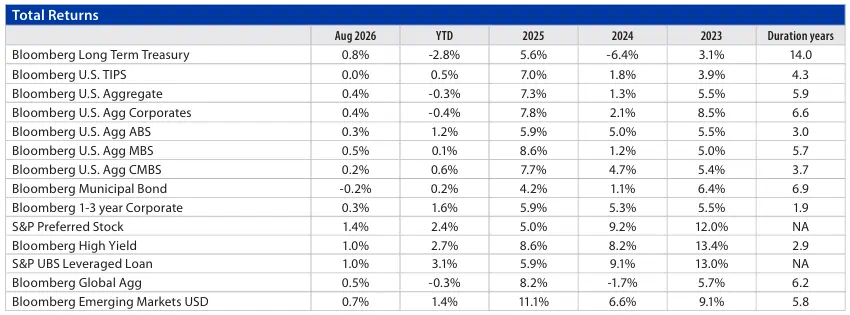
Fixed Income Indexes Characteristics
The Indexes mentioned are unmanaged statistical composites of stock market or bond market performance. Investing in an index is not possible.
For Index Definitions see: TouchstoneInvestments.com/insights/investment-terms-and-index-definitions
2024 – Economic growth continued unabated, driven by consumer spending. Inflation moderated further. The Federal Reserve pause continued until September, after which it cut interest rates three times by a total of 1 percentage point. Bond yields rose in response, resulting in only modest gains for high quality fixed income but better returns for riskier areas of fixed income.
2025 – The economy remained resilient, and inflation stayed sticky, keeping yields elevated but allowing high-quality intermediate maturity bonds to generate solid returns as the Fed cut rates late in the year. Steady growth and improving liquidity supported tighter spreads, driving performance in credit-sensitive areas of the fixed income market.
The Touchstone Asset Allocation Committee
The Touchstone Asset Allocation Committee (TAAC) consisting of Crit Thomas, CFA, CAIA – Global Market Strategist, Erik M. Aarts, CIMA – Vice President and Senior Fixed Income Strategist, and Tim Paulin, CFA – Senior Vice President, Investment Research and Product Management, develops in-depth asset allocation guidance using established and evolving methodologies, inputs and analysis and communicates its methods, findings and guidance to stakeholders. TAAC uses different approaches in its development of Strategic Allocation and Tactical Allocation that are designed to add value for financial professionals and their clients. TAAC meets regularly to assess market conditions and conducts deep dive analyses on specific asset classes which are delivered via the Asset Allocation Summary document. Please contact your Touchstone representative or call 800.638.8194 for more information.
A Word About Risk
Investing in fixed-income securities which can experience reduced liquidity during certain market events, lose their value as interest rates rise and are subject to credit risk which is the risk of deterioration in the financial condition of an issuer and/or general economic conditions that can cause the issuer to not make timely payments of principal and interest also causing the securities to decline in value and an investor can lose principal. When interest rates rise, the price of debt securities generally falls. Longer term securities are generally more volatile. Investment grade debt securities which may be downgraded by a Nationally Recognized Statistical Rating Organization (NRSRO) to below investment grade status. U.S. government agency securities which are neither issued nor guaranteed by the U.S. Treasury and are not guaranteed against price movements due to changing interest rates. Mortgage-backed securities and asset-backed securities are subject to the risks of prepayment, defaults, changing interest rates and at times, the financial condition of the issuer. Foreign securities carry the associated risks of economic and political instability, market liquidity, currency volatility and accounting standards that differ from those of U.S. markets and may offer less protection to investors. Emerging markets securities which are more likely to experience turmoil or rapid changes in market or economic conditions than developed countries.
Performance data quoted represents past performance, which is no guarantee of future results. The investment return and principal value of an investment in the Fund will fluctuate so that an investor’s shares, when redeemed, may be worth more or less than their original cost. Current performance may be higher or lower than performance data given. For performance information current to the most recent month-end, visit TouchstoneInvestments.com/mutual-funds.
Please consider the investment objectives, risks, charges and expenses of the fund carefully before investing. The prospectus and the summary prospectus contain this and other information about the Fund. To obtain a prospectus or a summary prospectus, contact your financial professional or download and/or request one on the resources section or call Touchstone at 800-638-8194. Please read the prospectus and/or summary prospectus carefully before investing.
Touchstone Funds are distributed by Touchstone Securities, LLC*
*A registered broker-dealer and member FINRA/SIPC.
Touchstone is a member of Western & Southern Financial Group
Not FDIC Insured | No Bank Guarantee | May Lose Value


