












Asset Allocation Chart of the Month
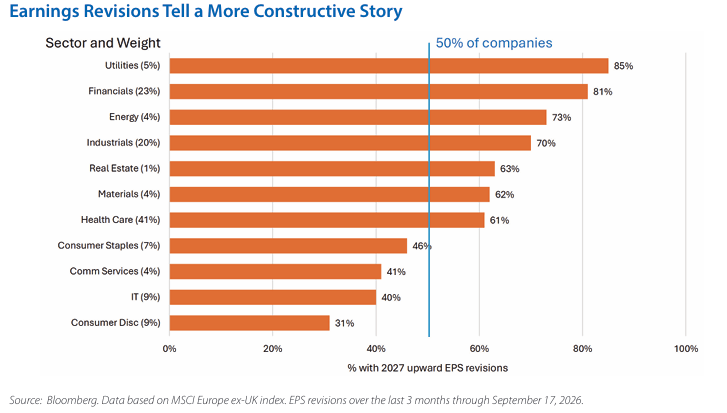
Earnings Growth Remains Strong and is Broadening
- Within developed markets Europe has been the laggard, likely due to fears over rising energy costs and interest rates, while fiscal challenges and geopolitical risks remain meaningful headwinds. Yet looking beneath the macro headlines, the outlook for European companies is proving more resilient than the economic narrative might suggest.
- Europe’s stock market is not simply a reflection of the European economy as many of its largest companies compete and generate revenues globally. As a result, weaker household activity or higher borrowing costs do not necessarily translate directly into weaker index earnings.
- Higher rates can also have a more nuanced impact on the market than on the economy. Banks and insurers, which have considerably larger weights in Europe than in the U.S., can benefit from a higher-rate environment. At the same time, increased fiscal spending on defense, infrastructure and other capital investment can support Industrials and Financials even as higher rates pressure consumers and other interest-sensitive areas.
- The economic backdrop has also been more resilient than feared. Eurozone growth has improved, with manufacturing activity strengthening across several countries. S&P Global’s August PMI data showed eurozone manufacturing growth accelerating to its strongest pace since early 2022, with Germany among the notable improvements.
- Most importantly, earnings have not cracked. Bloomberg notes that European earnings estimates have been revised higher for twenty consecutive weeks, the strongest momentum in roughly five years. Our analysis tells a similar story beneath the index: about 63% of companies with reported estimates have seen 2027 EPS estimates revised higher over the past three months, led by Financials, Industrials and Health Care.
- Takeaway: Europe’s risks are well known. What may be less appreciated is that those risks have yet to derail the earnings outlook. For investors focused only the macro headlines, the improvement beneath the surface may be easy to miss.
The Touchstone Asset Allocation Committee
The Touchstone Asset Allocation Committee (TAAC) consisting of Crit Thomas, CFA, CAIA – Global Market Strategist, Erik M. Aarts, CIMA – Vice President and Senior Fixed Income Strategist, and Tim Paulin, CFA – Senior Vice President, Investment Research and Product Management, develops in-depth asset allocation guidance using established and evolving methodologies, inputs and analysis and communicates its methods, findings and guidance to stakeholders. TAAC uses different approaches in its development of Strategic Allocation and Tactical Allocation that are designed to add value for financial professionals and their clients. TAAC meets regularly to assess market conditions and conducts deep dive analyses on specific asset classes which are delivered via the Asset Allocation Summary document. Please contact your Touchstone representative or call 800.638.8194 for more information.
A Word About Risk
Fixed-income securities can experience reduced liquidity during certain market events, lose their value as interest rates rise and are subject to credit risk which is the risk of deterioration in the financial condition of an issuer and/ or general economic conditions that can cause the issuer to not make timely payments of principal and interest also causing the securities to decline in value and an investor can lose principal. When interest rates rise, the price of debt securities generally falls. Longer term securities are generally more volatile. Investment grade debt securities may be downgraded by a Nationally Recognized Statistical Rating Organization to below investment grade status. Non-investment grade debt securities are considered speculative with respect to the issuers' ability to make timely payments of interest and principal, may lack liquidity and has had more frequent and larger price changes than other debt securities. Equities are subject to market volatility and loss. Growth stocks may be more volatile than investing in other stocks and may underperform when value investing is in favor. Value stocks may not appreciate in value as anticipated or may experience a decline in value. Stocks of large-cap companies may be unable to respond quickly to new competitive challenges. Stocks of small- and mid-cap companies may be subject to more erratic market movements than stocks of larger, more established companies. Investments in foreign, and emerging market securities carry the associated risks of economic and political instability, market liquidity, currency volatility and accounting standards that differ from those of U.S. markets and may offer less protection to investors. The risks associated with investing in foreign markets are magnified in emerging markets, due to their smaller and less developed economies.
The information provided reflects the research and opinion of Touchstone Investments as of the date indicated, and is subject to change without prior notice. Past performance is not indicative of future results. There is no assurance any of the trends mentioned will continue or forecasts will occur. Investing in certain sectors may involve additional risks and may not be appropriate for all investors. The indexes mentioned are unmanaged statistical composites of stock or bond market performance. Investing in an index is not possible. For Index Definitions see: TouchstoneInvestments.com/insights/investment-terms-and-index-definitions
Please consider the investment objectives, risks, charges and expenses of the fund carefully before investing. The prospectus and the summary prospectus contain this and other information about the Fund. To obtain a prospectus or a summary prospectus, contact your financial professional or download and/or request one on the resources section or call Touchstone at 800-638-8194. Please read the prospectus and/or summary prospectus carefully before investing.
Investment return and principal value of an investment in a Fund will fluctuate so that an investor's shares, when redeemed, may be worth more or less than their original cost. All investing involves risk.
Touchstone Funds are distributed by Touchstone Securities, LLC*
*A registered broker-dealer and member FINRA/SIPC.
Touchstone is a member of Western & Southern Financial Group
Not FDIC Insured | No Bank Guarantee | May Lose Value


