












Fixed Income
Weight: Moderate Underweight
We maintain moderate tactical underweight as we continue to see more attractive return opportunities in equities. Bond yields have become even more appealing, offsetting inflation risks, fiscal concerns, and a less communicative Fed.
Duration
Weight: Neutral
We shifted duration back to neutral as the risks have become more balanced. Heavy borrowing needs from the federal government and AI-related infrastructure investment are increasing competition for capital putting upward pressure on long-term yields.
U.S. Taxable Investment Grade
Weight: Neutral
We remain neutral. Yields are attractive, but significant data center-related issuance, particularly on the long end of the curve, creates additional competition for capital and argues for selectivity in issuer, maturity and structure.
U.S. Taxable Non-Investment Grade
Weight: Moderate Underweight
We remain underweight high-yield bonds. Credit spreads provide little cushion should inflation remain elevated or economic growth begins to slow.
Equities
Weight: Moderate Overweight
We maintain a moderate overweight, supported by resilient economic data and continued earnings strength. While AI remains the dominant market driver, there are some encouraging signs that earnings growth is broadening beyond AI-related companies.
U.S. Large Cap Blend
Weight: Moderate Overweight
We maintain a moderate overweight. Strong earnings growth and continued AI-related investment have supported equity markets. Constraints on data center buildout such as permitting and power needs could create some earnings risk, though AI demand remains very strong.
Growth
Weight: Slight Overweight
We tactically shifted Growth to a slight overweight. Strong earnings growth and continued AI-related investment remain supportive. Continued strength in AI demand and greater visibility into 2027 has increased our confidence, though the change was incremental as the risk profile is high.
Value
Weight: Neutral
We remain neutral. The Value index contains a diverse mix of defensive, cyclical, and even growth-oriented companies that have migrated from Growth benchmarks. While we see attractive opportunities within the universe, we believe they are best captured through active management.
U.S. Mid Cap
Weight: Neutral
We removed our slight overweight, shifting to neutral. Earnings revisions and breadth have improved, although mid caps have recently lagged large caps due to a slower rate of EPS growth. We decided to follow the relative earnings strength by adding to large cap growth.
U.S. Small Cap
Weight: Neutral
We remain neutral. Earnings and sales revision breadth have improved, although relative performance has yet to provide decisive confirmation and higher interest rates create a new headwind.
International Developed
Weight: Neutral
We remain neutral, though the outlook has improved modestly. Earnings have been materially better and European economic growth is modestly exceeding expectations. However, sustained higher energy prices and rates suggest a dose of caution is warranted.
International Emerging
Weight: Slight Underweight
We remain slightly underweight. EM returns have become increasingly dependent on three large, historically cyclical semiconductor companies. This concentration makes the asset class more dependent on company-specific fundamentals and less on the broader macro factors that typically guide our allocation decisions. 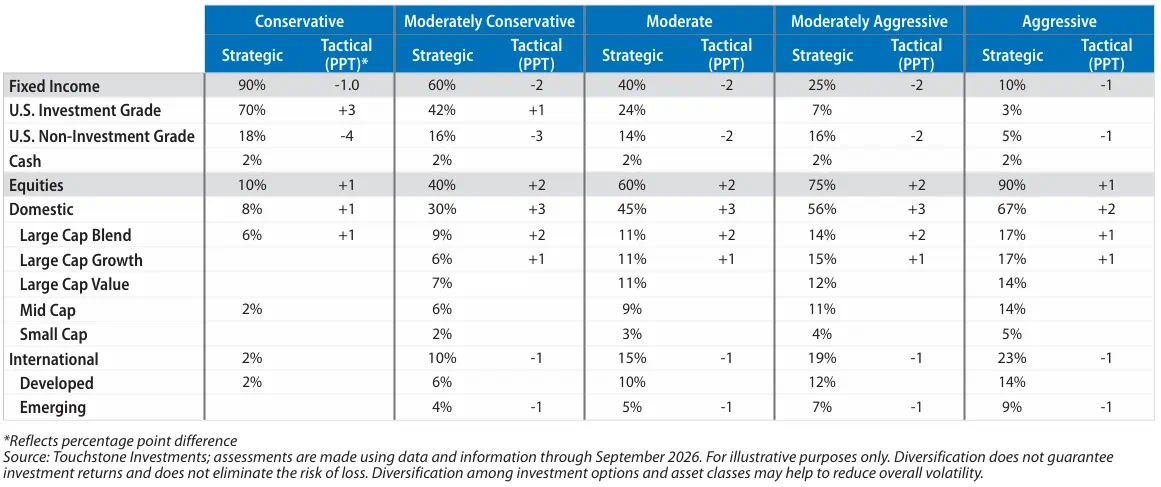
Strategic: Strategic asset allocation is a baseline allocation between asset classes established with a longer term focus and congruent with an investor’s investment goals and objectives. The allocation is meant to optimize the asset mix through methodical diversification in an attempt to maximize return and lessen risk.
Tactical: Tactical asset allocation is differentiated from strategic asset allocation by having a much shorter time horizon and the goal of adding alpha beyond what would be allowed through static strategic weights. Markets tend to be more volatile over shorter time horizons, while longer time frames tend to smooth out that volatility. That enhanced volatility in the short term creates the opportunity for either return enhancement and/or risk reduction by adding to or reducing weights of different asset classes.